Ongoing simulation study of closed-loop vision-language-action control for dual-arm humanoid manipulation — state-free vs state-conditioned inference in NVIDIA IsaacLab.
Robot Robotis SG2 AI Worker
Simulator NVIDIA IsaacLab
Model StarVLA — Qwen2.5-VL-3B + DiT-B
Dataset 2,000 demos · 306,766 transitions
GPU RTX 5090 32GB
This work uses StarVLA developed by the HKUST team. We deploy and evaluate it on the Robotis SG2 AI Worker as an independent simulation study prior to real-robot transfer.
Key results
50 fully randomized trials per variant — object position (8 slots), lighting, background, pegboard location, and robot initial pose all randomized each episode. Task: "Put the yellow paint brush into the crate."
State-free success
66%
33 / 50 · 200k steps
State-cond. success
28%
14 / 50 · 30k steps
Gap
+38pp
pp = percentage points
state-free advantage
Self-correction ✦
14%
state-free only · 0% state-cond.
Wrong arm ✦
24%
state-cond. only · 0% state-free
Optimal checkpoints
200k / 30k
nostate / state steps
State-free — 200k steps
Full success26 (66%)
66%
Self-corrected ✦7 (14%)
14%
Object fell7 (14%)
14%
Outside basket6 (12%)
12%
Failed grasp4 (8%)
8%
Wrong arm0 (0%)
State-conditioned — 30k steps
Full success14 (28%)
28%
Failed grasp12 (24%)
24%
Wrong arm ✦12 (24%)
24%
Wrong object7 (14%)
14%
Outside basket3 (6%)
6%
Object fell2 (4%)
4%
✦ Notable findings
Self-correction (state-free only): In 14% of trials the robot approached the wrong object, then visually re-assessed at the next chunk boundary and redirected to the correct target. Zero self-corrections in the state-conditioned variant.
Wrong arm failure (state-conditioned only): In 24% of trials the robot attempted to grasp a left-side object with the right arm — physically impossible and never demonstrated in training. Joint state conditioning corrupts the spatial reasoning the VLM would otherwise perform from the image.
Dataset
FFW-SG2 demonstration dataset collected on the physical Robotis SG2 AI Worker via kinesthetic teaching.
Total episodes
2,000
demonstrations
Transitions
306,766
state-action pairs
Avg length
153
steps per episode
Control rate
10
fps recording
Action space
19
DOF joint targets
Resolution
376×672
RGB head camera
Task
"Put the yellow paint brush into the crate."
Robot identifies target among multiple objects on an 8-slot pegboard, selects correct arm by object position, grasps, lifts, transports, and places into crate.
Format
FormatLeRobot v2.1
Data filesParquet per episode
Video codecAV1 · 376×672 · 10 fps
Chunks2 × 1,000 episodes
Train splitAll 2,000 episodes
Video demonstrations
Task: "Put the yellow paint brush into the crate." — object position, lighting, background, pegboard location, and robot initial pose all randomized each episode.
State-free · 200k stepsTwo representative trials — success and self-correction
Successful trial
Robot correctly identifies the paint brush, selects the appropriate arm, grasps, and places it into the crate in a single continuous motion.
Self-correction trial
Robot initially approaches the wrong object, visually re-assesses at the next chunk boundary, then redirects to grasp the correct target.
State-conditioned · 30k stepsThree representative trials — wrong arm and wrong object failures
Both models produce overconfident, spatially erratic trajectories beyond their optimal checkpoints — 200k for state-free, 30k for state-conditioned. This video shows the state-conditioned model at 400k steps.
Video files are hosted via Git LFS in this repository.
How we implemented state-free and state-conditioned inference
Two StarVLA variants fine-tuned on identical data with identical hyperparameters. The only difference is whether proprioceptive joint state is provided as a model input — both during fine-tuning and at inference.
State-free variant
Camera image + language only. No joint positions provided at any stage.
Checkpoint: steps_200000_pytorch_model.pt
Training precision: bfloat16
state_dim config: 19 (unused)
Server flag: --use_bf16
Bridge: no state= argument
State-conditioned variant
Camera image + language + 19 joint positions sin-cos encoded into 38 dimensions.
Checkpoint: steps_30000_pytorch_model.pt
Training precision: bfloat16
state_dim config: 38 (sin-cos)
Server flag: use_bf16
Bridge: state=joint_pos argument
The one-line difference in the inference bridge
In scripts/inference/starvla_inference.py, find the get_action call:
State-free — omit state= argument
action_chunk_norm = starvla_client.get_action(
    image=cam_image,
    lang=task_description,
    # no state= argument
)
State-conditioned — add state= argument
action_chunk_norm = starvla_client.get_action(
    image=cam_image,
    lang=task_description,
    state=joint_pos,   # ← add this line
)
Matching server checkpoint to inference mode
Mode
Server command
Bridge call
State-free
steps_200000
no state=
State-conditioned
steps_30000
state=joint_pos
Sin-cos state encoding — why 19 becomes 38
Each joint angle is replaced by its sine and cosine, doubling the dimension. This preserves angular continuity — joints at +π and −π map to the same point in sin-cos space.
StarVLA was fine-tuned with obs: ["image_0"] and use_proprio: false. Although the training dataset records joint state for every transition, the pipeline deliberately excluded it. The state-free model matches its training distribution exactly at inference. The camera provides implicit proprioception — arm positions are visible, object distances can be estimated from apparent size, and gripper state is directly observable. Any drift in one 16-step chunk is corrected when the next chunk is conditioned on the updated visual scene.
Checkpoint selection finding
State-free: optimal at 200k steps
Trained to 400k but best at 200k. Beyond this the model overfits to training positions and fails to generalize to randomized object locations and lighting.
State-conditioned: optimal at 30k steps
The harder joint state + visual learning problem leads to earlier overfitting. Model degrades rapidly after 30k — producing overconfident, spatially erratic outputs.
Checkpoint selection analysis
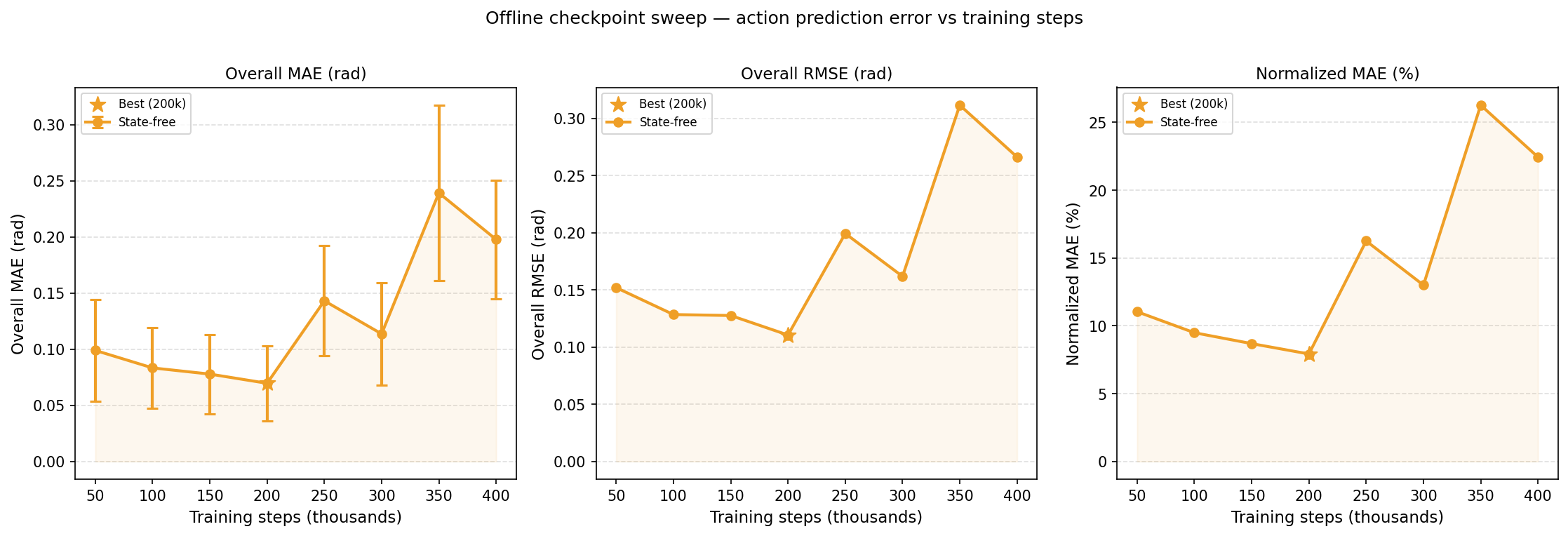
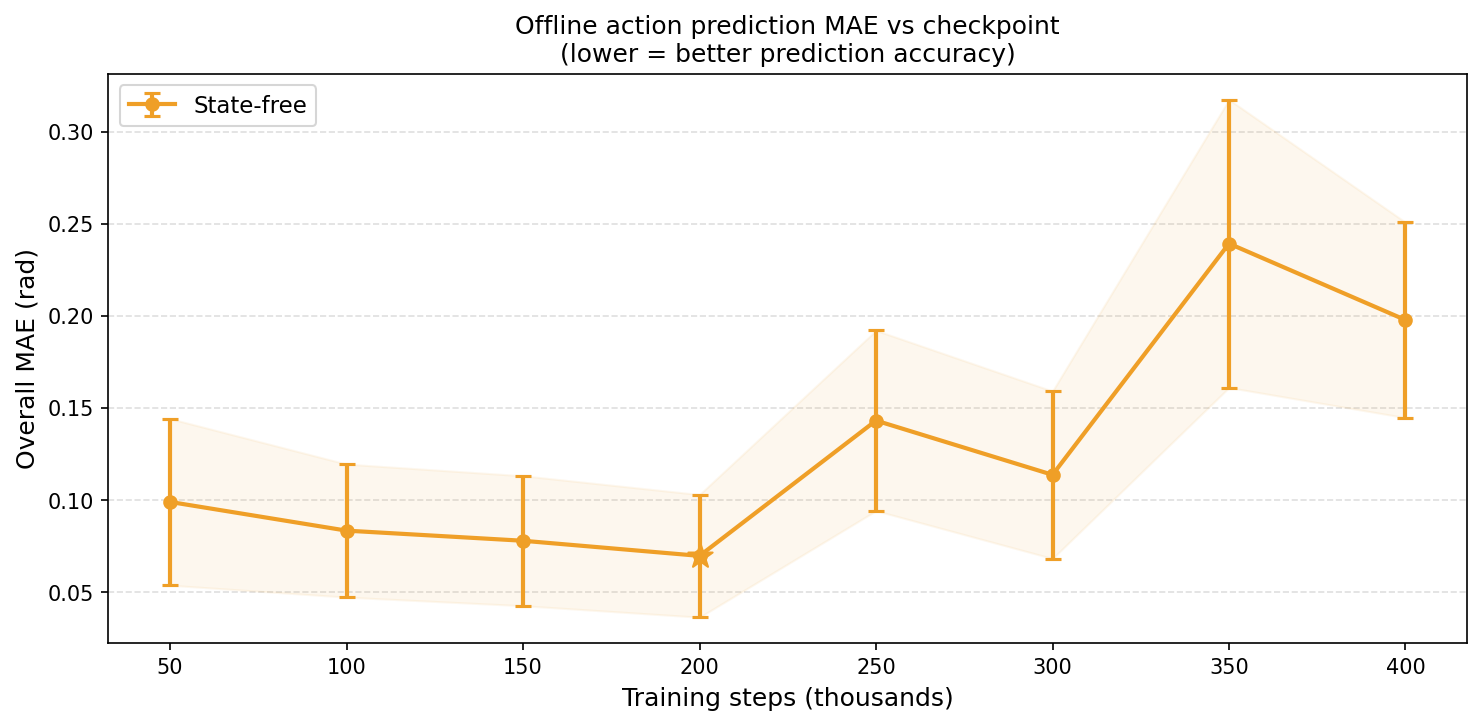
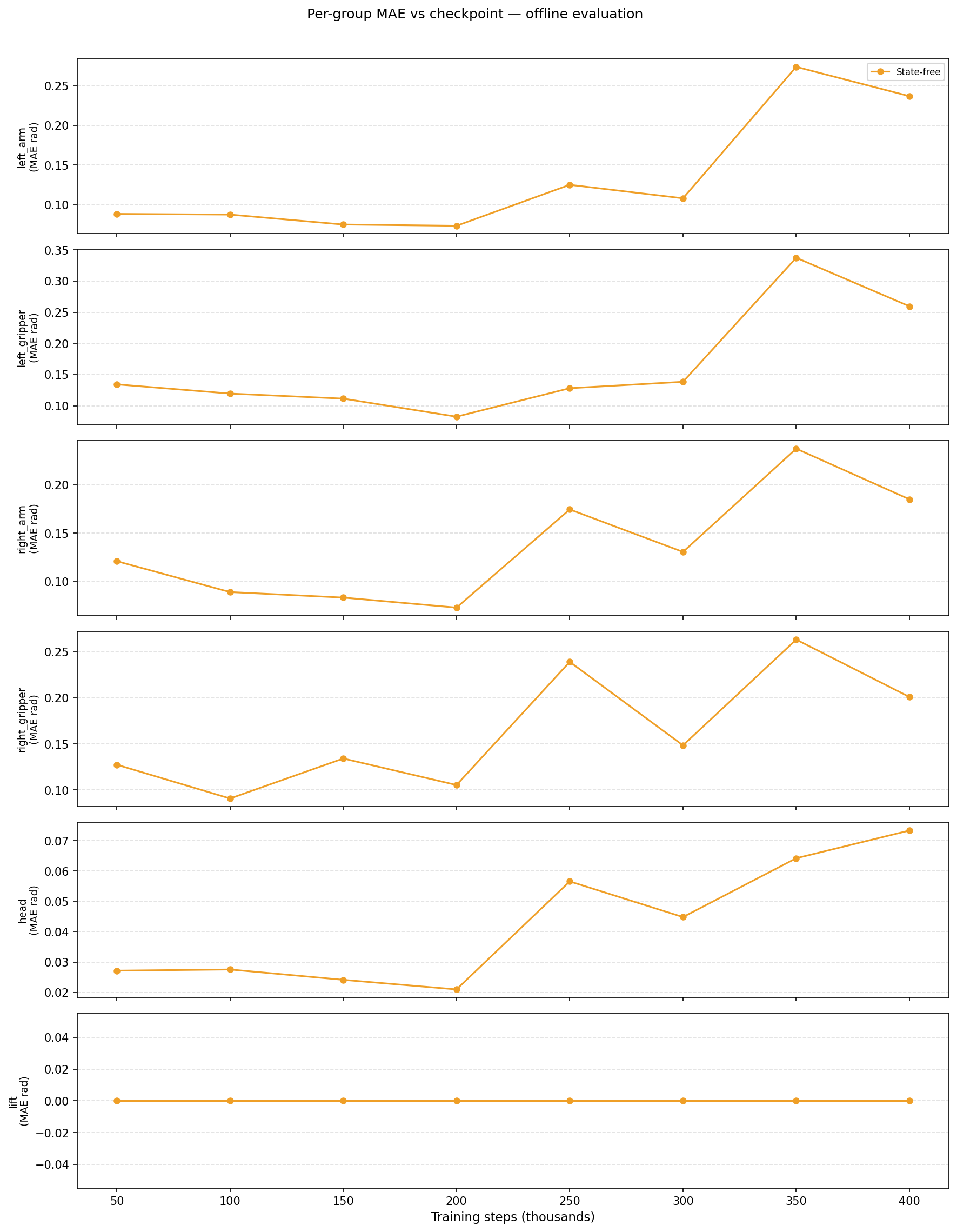
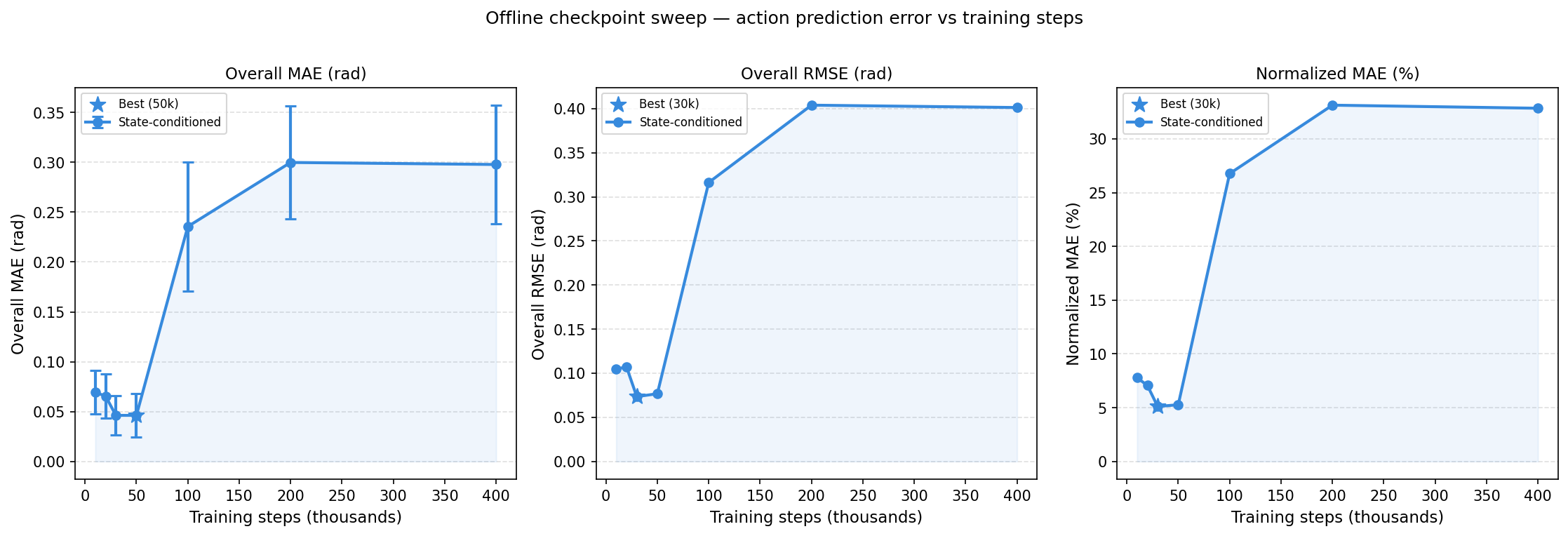
Offline action prediction error across training checkpoints — evaluated on 10 dataset episodes without simulation. Shows where each model peaks and degrades.
State-freePeaks at 200k steps · degrades gradually · optimal MAE = 0.071 rad
MAE · RMSE · Normalized MAE vs training steps
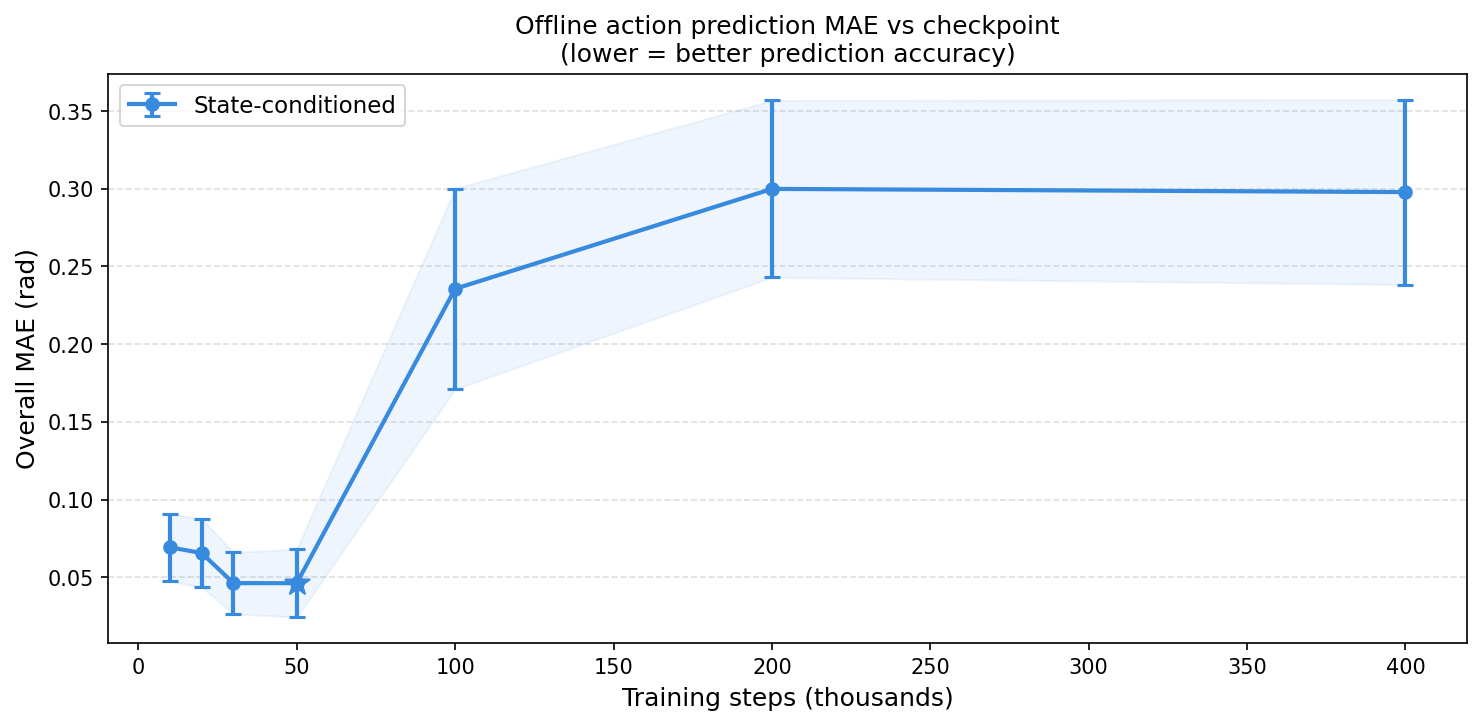
Overall MAE with error bars
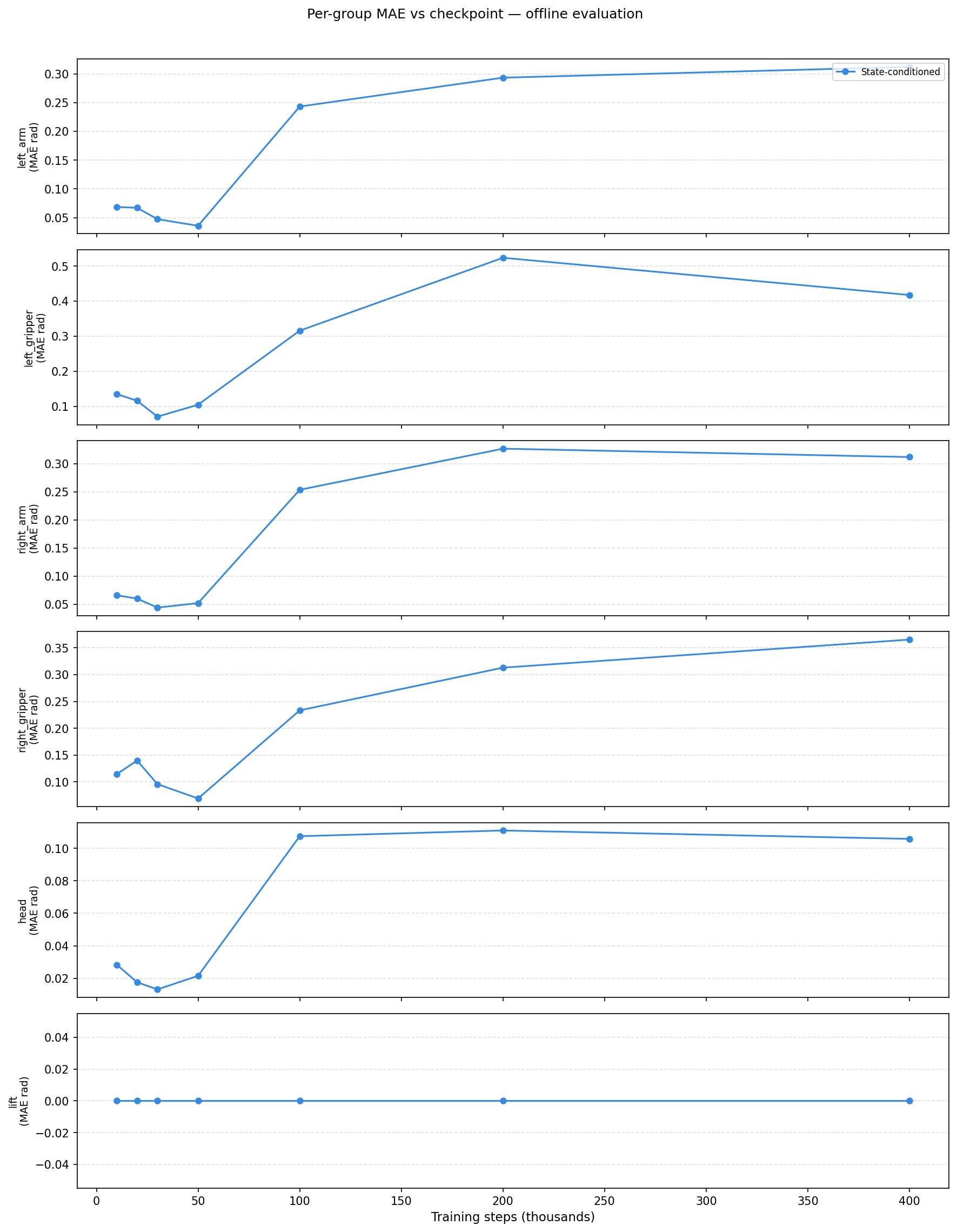
Per joint group MAE vs training steps
State-conditionedPeaks at 30k–50k steps · collapses rapidly · MAE triples by 100k steps
MAE · RMSE · Normalized MAE vs training steps
Overall MAE with error bars
Per joint group MAE vs training steps
Key findings
State-free: Improves steadily from 50k (MAE = 0.100 rad) to optimal at 200k (MAE = 0.071 rad), then degrades gradually — reaching 0.239 rad at 350k.
State-conditioned: Peaks at 30k–50k (MAE ≈ 0.047 rad) then collapses to 0.237 rad at 100k, plateauing at ~0.30 rad from 200k to 400k. By 400k normalized MAE reaches 32% of the action range.
Metric
State-free best (200k)
State-cond. best (30k)
State-free 400k
State-cond. 400k
Overall MAE (rad)
0.071
0.047
0.199
0.298
Overall RMSE (rad)
0.110
0.073
0.269
0.401
Normalized MAE (%)
8.1%
5.5%
22.3%
32.1%
Degradation
—
Gradual after 200k
Cliff edge after 50k
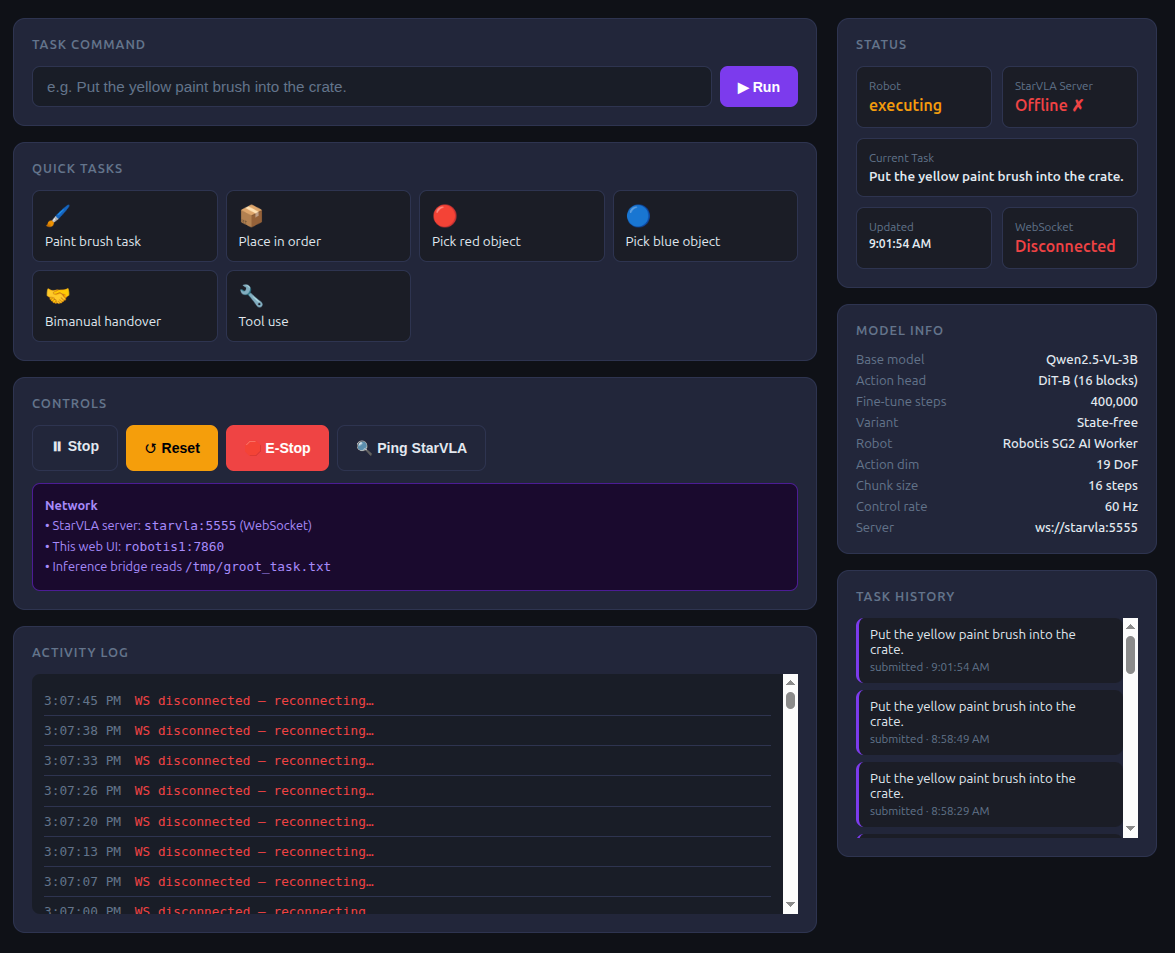
Web GUI for simulation control
FastAPI + WebSocket browser interface for submitting tasks, monitoring execution, and controlling the simulation without terminal access.
⌨
Task input
Free-form language instruction sent to the robot in real time.
⚡
Quick tasks
Pre-configured buttons for common task descriptions.
↺
Reset
Resets IsaacLab and randomizes all scene parameters.
⏸
Stop
Halts execution — robot holds current pose.
📡
Live status
WebSocket shows real-time execution status.
📋
Task history
Logs all submitted tasks with timestamps.
Web GUI running on http://localhost:8000 — task input, quick task buttons, reset/stop controls, and live WebSocket status log.
The GUI writes instructions to /tmp/groot_task.txt. The inference loop polls this every simulation step at 60 Hz. Special commands __RESET__ and __STOP__ control the environment without interrupting simulation.
Uses StarVLA by the HKUST team · Deployed on Robotis SG2 AI Worker · NVIDIA IsaacLab · Ongoing study